I have cancer but I also have a life and an opinion
Stage IV Homelessness
I received a poem from the mother of a missing man. She characterized his condition as “Stage 4 Homelessness.” She described Stage 4 Homelessness as similar to Stage 4 Cancer. Stage 4 Homelessness is terminal and in the final states of mental illness, despair, chemical dependency, poor physical health, et al.
She has met homeless individuals who claim to know her son and assured her that he is alive but “crazy” and eating out of trashcans. She has done everything she knows to do to help her son, but it has come to his current state.
She lamented that the United States government sends billions of dollars to foreign countries but neglect their citizens and the mental health crisis that she is unfortunately so familiar.
She has left her contact information with the county medical examiner’s office where her son is known to live in homeless encampments, under bridges, and on the street.
She explained that she couldn’t sleep one night as she worried about her son. She wrote this poem to express her emotion:
“Mamas and Jesus
Mamas and Jesus never give up
When your world gets hard and rough
Many may think it’s totally hopeless cause
some may even be homeless
but the constant faith of a mama’s love
and the good Lord looking down from above can heal the hardest heart
There may be years you are apart
From addiction and illness it don’t matter what
Mamas and Jesus never give up!
So no matter how many years or how many miles you roam
No matter if a shelter, a tent or under a bridge is now your home
remember at night wherever you lay
There’s a momma out there that’s still gonna pray
For God’s protection and peace to surround you each day
Even if others say it’s not enough
Mamas and Jesus never give up!”[1]
In the late 1980’s the Tulsa Center for Behavioral Science studied Tulsa’s homeless and found that 30% suffered some form of mental illness. Law enforcement routinely interacts with the homeless population when called to intervene with a mentally ill homeless person in crisis, or a homeless person who is a victim or suspect in a crime. Many military veterans are also homeless with a large percentage suffering from Post-Traumatic Stress Disorder (PTSD).
Nothing has changed since the 1980’s study. In an article published in 2024 the key takeaways were:
- Over two-thirds of people living on the streets or in shelters are currently battling some form of mental illness
- Men are more likely to be affected than women, although rates for both genders are high
- Rates of mental illness among the homeless may be rising over time[2]
Finding a mentally ill homeless person in crisis is common. I soon became proficient in articulating probable cause in a Peace Officer’s Affidavit for Emergency Detention (EOD). When someone is incapable of caring for themselves or are a danger to themselves or others then law enforcement officers take that individual into protective custody and present them to a physician who will evaluate the individual’s mental health.
The law enforcement officer is required to document their observations in a Peace Officer’s Affidavit For Emergency Detention. The officer must describe the conditions and behavior that they observed presented by the individual. If the physician concurs with the officer, then the individual is treated.
It seems to be a vicious circle of crisis, treatment, positive response to treatment, the individual then goes off their medication and eventually goes back into crisis.
It sometimes seems that law enforcement is called to address homelessness that involves only the homeless individual’s desire for someone else to solve their problem. As a field officer whose beat covered numerous homeless resource centers, I routinely received calls for service involving homeless individuals. I was frustrated as I felt incapable of solving a problem that the individual had no interest in expending energy to fix their own calamity.
What do you do for individuals who wear the same clothing for months on end never changing or washing their bodies or clothes. How do you deal with someone whose mindset prefers to sleep beneath a bridge over a warm bed in a safe shelter? How do you provide care for someone who is as indiscriminate in their promiscuity as they are with whom they share a needle?
The Tulsa Center for Behavioral Sciences coined a term to describe the homeless after their study. They referred to it as “The Homeless Lifestyle.” This is the chosen lifestyle for these individuals. When you look at the total population as a “bell curve” there are those on one extreme who live opulent and extravagant lifestyles – “the lifestyles of the rich and famous.” Then there are those of us in the middle and on the other extreme of the bell curve are those who live the Homeless Lifestyle under bridges or in cardboard boxes on city sidewalks.
Wikipedia describe Trolls, “A troll is a being in Scandinavian folklore, including Norse mythology. In Old Norse sources, beings described as trolls dwell in isolated rocks, mountains, or caves, live together in small family units, and are rarely helpful to human beings.
In later Scandinavian folklore, trolls became beings in their own right, where they live far from human habitation, are not Christianized, and are considered dangerous to human beings. Depending on the source, their appearance varies greatly; trolls may be ugly and slow-witted, or look and behave exactly like human beings, with no particularly grotesque characteristic about them.”
This description is remarkably similar to today’s homeless population. Perhaps the Homeless Lifestyle has always existed with Trolls now referred to as homeless.
Law enforcement’s task is to provide for the safety of its citizens and enforce the law. Law enforcement executes these tasks with professionalism, empathy, and compassion.
When feeling aggravated and frustrated when you see a homeless person, stop and realize that somewhere there is a mother praying for her child.
Drugs – The Scourge
Crime, drugs, mental illness, homelessness oh my!
Imagine if you will that there is something so powerful that you will do anything for it: steal, kill, sell your children, sell yourself. Imagine something that controls your mind, alters your personality, and keeps you subservient.
You are not in the Twilight Zone,[3] you are in America. Marijuana, cocaine, heroin, methamphetamine, opioids, jet fuel, gold spray paint, toluene (paint thinner/glue), “incense,” and just about anything imaginable or unimaginable are used “recreationally” to reduce pain, increase/decrease metabolism, or just get high. Recreation is a euphemism used by advocates of the recreational drug lifestyle to validate their behavior.
The definition of recreation “is an activity done for enjoyment when one is not working.” “Taking part in recreational activities, especially outdoors, can greatly improve physical health.”[4] So, when you are doing recreation, it is healthy and enables you to return to work recharged and refreshed.
So then, injecting heroin into your veins with a needle that has been used by a dozen others also recreating is therefore healthy and a benefit to society. Selling your infant to the person who traded you a “rock of cocaine” should be encouraged as healthy. After all, it takes a village to raise a child . . . assuming you believe the village idiot.
Using drugs is not recreation. Using drugs destroys your mind and body, your relationships, your community, and ultimately your country. Benjamin Franklin wrote,
“For the want of a nail the shoe was lost,
For the want of a shoe the horse was lost,
For the want of a horse the rider was lost,
For the want of a rider the battle was lost,
For the want of a battle the kingdom was lost,
And all for the want of a horseshoe-nail.”
One by one our precious citizens are destroyed as they consume drugs. Individual to individual, generation by generation this nation is being destroyed as we accept the recreational past time of using drugs to pass the time.
Every American is a nail that holds the fabric of our nation together. Every lost nail is one less that supports our common good. Every nail is precious to our survival.
Law enforcement has reported increasing calls for service involving mental illness precipitated by psychosis, destitute drug addiction, and increased homelessness – all resulting from making drug offenses legal. The March 2020 Examination of the Relationship between Drugs and Crime in the Midwest[5] Midwest HIDTA[6] found the relationship between drugs and crime to be “irrefutable.”
How do drugs impact homicide investigations? Key findings of the Midwest High Intensity Drug Trafficking Area (Midwest HIDTA) report show that 40% of the region’s homicides are “attributable to drug use and or trafficking.” Findings also reports more than 70,000 drug overdose deaths in 2017 calling drug trafficking “the most murderous criminal activity in the history of the United States.”[7]
In 1974 the Police Foundation and the Kansas City, Missouri police department conducted The Kansas City Preventive Patrol Experiment.[8] The result was a 910-page technical report. I will summarize it in two statements:
- Routine patrol does not impact crime.
- Law enforcement resources specifically directed impacts crime.
As a young patrol officer reading this, I was suddenly struck with the realization that number one was accurate. I recalled armed robberies of businesses that I had driven past only minutes before or responded to burglaries in residential neighborhoods that I had patrolled hoping to catch . . . a burglar.
I read National Institute of Justice/Bureau of Justice Statistics research papers discussing drug use by incarcerated offenders. Key findings from drug related crime statistics from the National Center for Drug Abuse Statistics indicate that 80% of prison inmates use drugs or alcohol.[9] These studies chronicled the fact that a criminal’s drug use was at its peak when they were arrested for the crime for which they were serving time. The Midwest HIDTA study includes Department of Justice studies that tracked released convicts finding that 44% reoffended within the first year of their release, 83% reoffended during the study period, released prisoners were arrested on average five times during the study period, with 77% for non-drug crime. The Oklahoma Retail Crime Association saw a 64% increase in theft after decriminalization of drug offenses.
AONE’s position paper reports 700 overdose deaths each year in Oklahoma. They also report that treatment programs promised in order to pass decriminalization laws have never been funded. This in itself is interesting to me as law makers apparently realized that treatment programs would be necessary when decriminalizing drug offenses.
The conclusion being that drugs pushed the crime rate as individuals committed crimes to pay for their ever-growing demand for drugs. These individuals were either so active committing crimes or careless due to their brain addled chemical dependency that they were captured, convicted, and imprisoned.
My agency, in an effort to address crime, developed a “Repeat Offender Program”. The program targeted repeat offenders to address the most active criminals in the jurisdiction. I examined the arrest histories of all the repeat offenders that had been identified.
All had been arrested for several different crimes. All had been arrested numerous times with multiple arrests for several different crimes. A burglar was not a burglar, they were a criminal having been arrested for various other offenses in addition to burglary. I found that the most common crime with the most numerous arrests for that crime were drug offenses.
All crimes paled in comparison to drug arrests among all repeat offenders. These were robbers, burglars, fraud and forgery arrestees, thieves, domestic violence offenders, even individuals caught violating fish and game laws. Of all arrests by these individuals their most common offense was drug arrests. Possessing, manufacturing, trafficking, any aspect of drugs that could be violated were violated by these repeat offenders.
Is the answer to decriminalize drug use? Decriminalizing drugs will not end dependency. Decriminalizing drugs will not heal their mental health. Decriminalizing drugs will not reduce homelessness. There must be consequences to behavior.
When you touch a hot stove, you learn that you get burned. Hopefully you also learn not to touch a hot stove. The measure of your intelligence will determine how many times you are burned. There are consequences. You are responsible for your behavior not the consequences of that behavior. There must be consequences commensurate with your behavior.
If you choose to use drugs and point guns at people to force them to give you money to enable you to buy more drugs there should be consequences. Or if you cut out the middle man and point guns at your drug dealer to get drugs there will be consequences. AONE points out the success of consequences when Oklahoma worked to outlaw incense, “K2”, or “spice” as it was called. Young Oklahomans were experiencing “severe dystonic reactions”[10] to this synthetic cannabis product sold in convenience stores. Making this product illegal and enforcing the law eliminated this problem.
My point is to combine The Kansas City Preventive Patrol Experiment, the second point above: Law enforcement resources directed specifically impact crime, with what we know about criminal drug use and repeat offenders into a policing strategy. You may not know where and when the next drug/liquor/convenience store will be robbed but you should know where the drug houses are located.
As a field officer another officer and I routinely served drug search warrants on houses within our beats. Russell, aka Buffy, aka Buffalo Head, aka Rock, aka Russ Buffington, aka Buffy Love, was an incredibly resourceful police officer. One day while sitting outside of a court room waiting to testify, Buffy struck up a conversation with a man sentenced to community service who was sweeping the floor.
Through their conversation the man said that he could buy drugs anywhere in town. Consequently “John” became our confidential informant through a series of successful “controlled buys.” By the end of this successful relationship John was weighing in on our discussions regarding probable cause and investigative issues facing our endeavors. John, while a street person, was very intelligent and quick to understand how this process must be prosecuted. John would make the buys, and we would return with a search warrant and take everyone to jail, found breaking the law. You don’t have to be an undercover detective assigned to Vice/Narcotics to enforce drug laws; you just must be resourceful and willing to work.
When you serve a search warrant and kick the door on a drug house those who are found inside and go to jail will not kill, rob, burgle, defraud, or beat their children later in the evening. You have directed your assets to effectively address the crime in your jurisdiction by preventing crime and reducing victimization.
If the touchy-feely part of your personality needs to be assuaged, you can interdict these individual’s criminal behavior and chemical dependency through programs to end their dependency, provide vocational training, provide mental health services, etc. while they are incarcerated. There must be programs however, to substitute for the individual’s need to use drugs and re-offend. If the programs are successful, you and everyone can enjoy a win-win. And who doesn’t enjoy a win-win?
Until those who support decriminalizing drugs while promoting the recreational use of drugs are stopped and exposed as benefitting financially from the sale of these drugs they will continue to eat away at our society, one nail at a time, until all is lost.
Drugs Kill
More than four (4) times as many people died from drug overdose (OD) than from homicide in the first month of 2023.
- 107,941 drug overdose deaths were reported in 2022.
- OD death totals in America have increased 53.5% between 2019 and 2022.
- In 2023, drug overdose deaths exceeded homicides by 338.6% and suicides by 103.0%[11]
One way or another, drugs kill you. The Association of Oklahoma Narcotic Enforcers (AONE)[12] released a position paper on February 8, 2021 entitled “The Decriminalization of Drug Offenses and Criminal Justice Reform.”[13] The report chronicles the “disastrous consequences” resulting from the decriminalization of drug offenses. Drug consumption increased exponentially after decriminalization due to the “perceived threat” of illicit drugs was reduced.
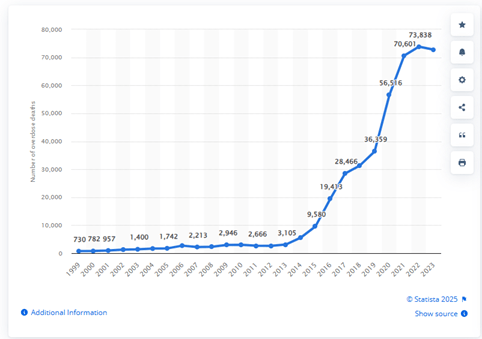
This graph from Statista shows the exponential rise in fentanyl deaths between 1999 and 2023!
Number of overdose deaths from fentanyl in the U.S. from 1999 to 2023[14]
What if Hitler sent his troops into countries in plain clothes, with their families, instead of invading foreign nations using infantry, tanks, and bombers? Within a couple of generations, or less, German military personnel could infiltrate local, county, state, and federal governments eventually re-creating or destroying a country without ever firing a shot.
What if foreign governments changed the rules of warfare? What if governments sought to defeat the United States without guns, bombers, carriers or battleships with us paying for our own overthrow? How would they do it and make obscene amounts of money at the same time?
Consider drug use statistics from the National Center for Drug Use Statistics:
- Over half of people twelve years old and older have used illicit drugs.
- Drugs have killed 1.15 million Americans since 1999.
- Our tax dollars for federal drug control were nearly $45 billion dollars in 2024.
Consider this:
- Drugs have killed 1.15 million Americans since 1999.
- All U.S. wars from the Revolutionary through the Persian Gulf have killed 990,744 Americans.[15]
More Americans have been killed by drugs in the last twenty-six years than all wars in the last 250!
Which is the most effective warfare, armies or drugs?
Where do drugs come from?
- Afghanistan is the biggest producer of opium worldwide.
- Bolivia is the source of the world’s largest production of both coca leaves and cocaine.
- Brazil is now the world’s second-largest producer of cocaine after Bolivia.
- Columbia is the world’s biggest producer of coca leaves.
- The Dominican Republic is the world’s biggest exporter of cannabis. The Dominican Republic is also an important transit point for cocaine, arriving from South America, as well as synthetic drugs like fentanyl.
- Laos is the world’s biggest producer of crystal meth, or “ice.” Laos is also a major exporter of heroin.
- Mexico is the source of 90% of the world’s illicit cannabis, and a significant producer of heroin. “Mexico stands as the primary source of fentanyl.”[16] Mexican cartels are the primary actors in the global drug trafficking industry, and the country remains a significant transit point for illicit substances.
- China provides Mexico with chemicals or “precursors” which are the ingredients needed to manufacture fentanyl.
- Nigeria is the world’s biggest supplier of cannabis. Nigeria is also a major source of the synthetic drug “ice,” or methamphetamine.
- Philippines is a source of methamphetamine.[17]
Slowly over time individuals, organizations, cartels, are destabilizing our Country and making enormous profits at the same time. What a way to fight a war!
Just as American service men no longer use muskets our enemies no longer use arms at all to kill our citizens and create mental health issues among a significantly larger population.
These graphs below show a direct correlation between drugs and mental illness. This is a war that the United States is losing.
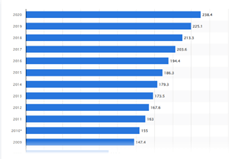
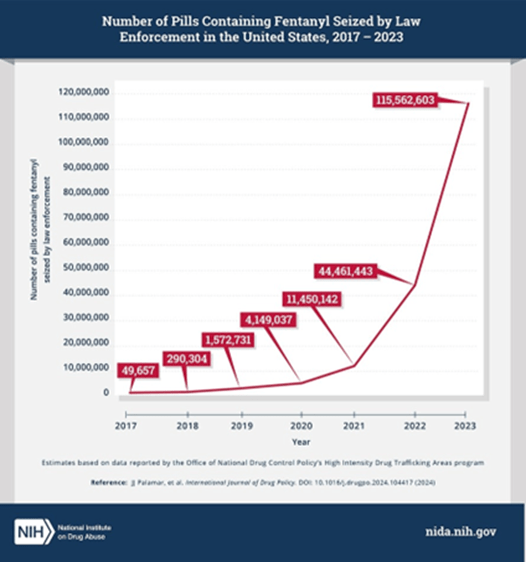
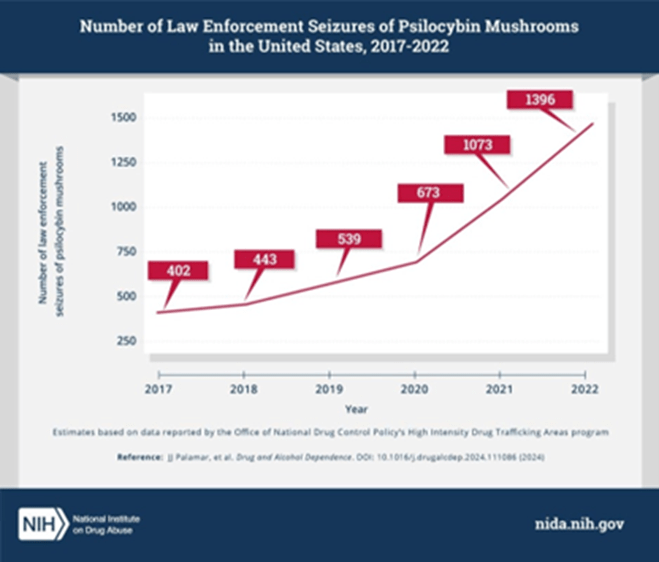
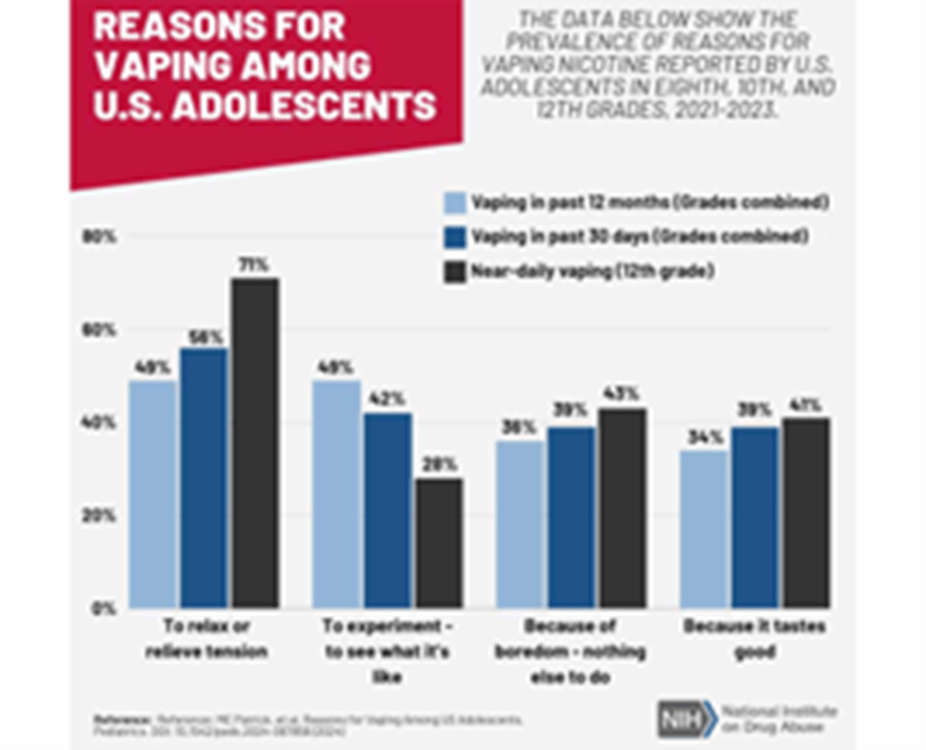
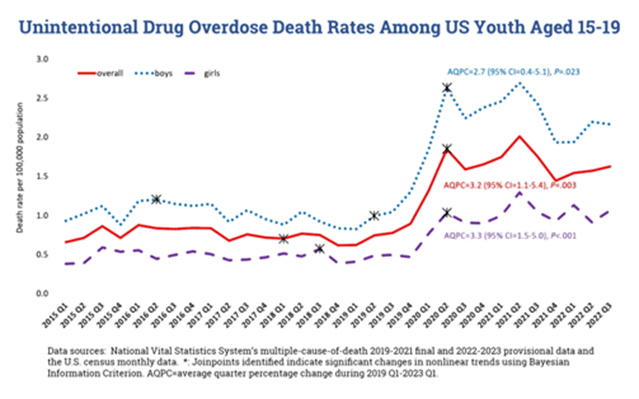
Adolescents[18] cite the reasons for vaping as “to relax, relieve tension, boredom/nothing else to do, to experiment, or because it tastes good. See the graph above. A study at Columbia University found that adolescents who vape have “an increased likelihood of high levels of binge drinking and cannabis usage.”[19] There are adolescents vaping because they are bored or stressed out and half our youths 12 years old and older have used illicit drugs. Overdose deaths among youths between the ages of 15 and 19 have increased dramatically since 2019. Since 2017 drug seizures of fentanyl and psilocybin mushrooms have increased exponentially (see graphs above).
The United States is losing the war on drugs. We are losing our next generation because of drugs and the mental illness resulting from it’s use.
America is not just losing its war on drugs; it is losing its republic. Individuals, governments, cartels, syndicates, are destroying the United States. The United States is being invaded and occupied by foreign nationals intent on ending our culture, way of life, economy, and government. They are infiltrating our school boards, city councils, state and federal legislatures. They are poisoning us with illicit drugs, food, pharmaceuticals, and moral decay. This is not the warfare we have fought in the past.
During the Revolutionary War Francis Marion[20] turned warfare upside down. Rather than line up against the British and shoot it out on a level playing field as had been done for decades he used “irregular warfare.” He is considered the father of guerrilla warfare, considered quite unsporting to the British at the time.
Later in America’s Civil War Union General William Tecumseh Sherman, proved that there was nothing civil about war. He believed that “War is cruelty. There is no use trying to reform it. The crueler it is, the sooner it will be over . . . It is only those who have neither fired a shot nor heard the shrieks and groans of the wounded who cry aloud for blood, for vengeance, for desolation. War is hell.”
War is hell
Wake up and smell the roses America! We are living in a hell created by individuals both foreign and domestic whose weapons are pride, greed, lust, envy, gluttony, wrath, and sloth, the seven deadly sins. Their goals are conquest, war, famine, and death to America, the four horsemen of the apocalypse.
It is becoming impossible for America to fight any war much less one that is taking place within our national boundaries. The United States Army Public Affairs Office reports that 71% of our nation’s youth do not qualify for military service. They cite obesity, drugs, physical and mental health problems, misconduct, and aptitude.[21] If you doubt that our Republic is in peril, consider that only three in ten youth can defend your country!
Joseph Goebbels is credited with saying “if you tell a lie big enough and keep repeating it, people will eventually come to believe it. The lie can be maintained only for such time as the State can shield the people from the political, economic and/or military consequences of the lie. It thus becomes vitally important for the State to use all its powers to repress dissent, for the truth is the moral enemy of the lie, and thus by extension the truth becomes the greatest enemy of the State.
Researchers refute that Nazi propogandist Joseph Goebbels said this which reinforces the point the statement makes about the truth. What is the truth? Who can we trust? It’s time to “gird your loins”[22] to learn the truth and expose it. Do you prefer the consequences of a lie over the consequences of the truth?
It’s time to vote like your life depends on it. Because it does. Your life, your children’s and grandchildren’s lives depend on what you do now because time is of the essence! It’s time to learn the truth about what is happening to America. Arm yourself with knowledge and the truth. Don’t expect to find the truth easily, you’re going to have to dig and work like hell because war is hell.
Appendix
Table 1. Principal Wars or Conflicts in Which the United States Participated: U.S. Military Personnel Serving and Casualties[23]
(1775-1991)
| Casualties | ||||||
| War or Conflict | Branch of Service | Number Serving | Total Deaths | Battle Deaths | Other Deaths | Wounds Not Mortala |
| Revolutionary Warb 1775-1783 | Total | — | 4,435 | 4,435 | — | 6,188 |
| Army | — | 4,044 | 4,044 | — | 6,004 | |
| Navy | — | 342 | 342 | — | 114 | |
| Marines | — | 49 | 49 | — | 70 | |
| War of 1812c 1812-1815 | Total | 286,730 | 2,260 | 2,260 | — | 4,505 |
| Army | — | 1,950 | 1,950 | — | 4,000 | |
| Navy | — | 265 | 265 | — | 439 | |
| Marines | — | 45 | 45 | — | 66 | |
| Mexican Warc 1846-1848 | Total | 78,718 | 13,283 | 1,733 | 11,550 | 4,152 |
| Army | — | 13,271 | 1,721 | 11,550 | 4,102 | |
| Navy | — | 1 | 1 | — | 3 | |
| Marines | — | 11 | 11 | — | 47 | |
| Civil Warcd (Union Forces Only)e 1861-1865 | Total | 2,213,363 | 364,511 | 140,414 | 224,097 | 281,881 |
| Army | 2,128,948 | 359,528 | 138,154 | 221,374 | 280,040 | |
| Navy | 84,415 | 4,523 | 2,112 | 2,411 | 1,710 | |
| Marines | f | 460 | 148 | 312 | 131 | |
| Spanish-American War 1898-1901 | Total | 306,760 | 2,446 | 385 | 2,061 | 1,662 |
| Armyg | 280,564 | 2,430 | 369 | 2,061 | 1,594 | |
| Navy | 22,875 | 10 | 10 | — | 47 | |
| Marines | 3,321 | 6 | 6 | — | 21 | |
| World War I 1917-1918 | Total | 4,734,991 | 116,516 | 53,402 | 63,114 | 204,002 |
| Armyh | 4,057,101 | 106,378 | 50,510 | 55,868 | 193,663 | |
| Navy | 599,051 | 7,287 | 431 | 6,856 | 819 | |
| Marines | 78,839 | 2,851 | 2,461 | 390 | 9,520 | |
| World War IIi 1941-1946j | Total | 16,112,566 | 405,399 | 291,557 | 113,842 | 670,846 |
| Armyk | 11,260,000 | 318,274 | 234,874 | 83,400 | 565,861 | |
| Navyl | 4,183,466 | 62,614 | 36,950 | 25,664 | 37,778 | |
| Marines | 669,100 | 24,511 | 19,733 | 4,778 | 67,207 | |
| Korean Warm 1950-1953 | Total | 5,720,000 | 36,574 | 33,739 | 2,835 | 103,284 |
| Army | 2,834,000 | 29,856 | 27,731 | 2,125 | 77,596 | |
| Navy | 1,177,000 | 657 | 503 | 154 | 1,576 | |
| Marines | 424,000 | 4,509 | 4,267 | 242 | 23,744 | |
| Air Force | 1,285,000 | 1,552 | 1,238 | 314 | 368 | |
| Vietnam Conflictn 1964-1973 | Total | 8,744,000 | 58,220 | 47,434 | 10,786 | Hospital Care: 153,303 No Hospital Care: 150,341 |
| Army | 4,368,000 | 38,224 | 30,963 | 7,261 | Hosp. Care: 96,802 No Hosp. Care: 104,723 | |
| Navy | 1,842,000 | 2,566 | 1,631 | 935 | Hosp. Care: 4,178 No Hosp. Care: 5,898 | |
| Marines | 794,000 | 14,844 | 13,095 | 1,749 | Hosp. Care: 51,392 No Hosp. Care: 37,202 | |
| Air Force | 1,740,000 | 2,586 | 1,745 | 841 | Hosp. Care: 931 No Hosp. Care: 2,518 | |
| Persian Gulf Waro 1990-1991 | Total | 2,225,000 | 383 | 148 | 235 | 467 |
| Army | 782,000 | 224 | 98 | 126 | 354 | |
| Navy | 669,000 | 56 | 6 | 50 | 12 | |
| Marines | 213,000 | 68 | 24 | 44 | 92 | |
| Air Force | 561,000 | 35 | 20 | 15 | 9 | |
Source: Defense Casualty Analysis System (DCAS), https://dcas.dmdc.osd.mil/dcas/pages/report_principal_wars.xhtml.
The correlation between the rise in illicit drug use and the rise in mental illness in the United States is a complex and multi-faceted issue, influenced by several factors, including societal trends, medical advances, and changes in policy. Here’s a broad outline of how these two trends have evolved and some general insights into their relationship.
1. Historical Trends in Mental Illness and Drug Use:
- 1940s-1960s: Mental Illness Awareness
- Mental illness awareness and diagnoses were relatively low.
- Illicit drug use (such as marijuana and heroin) was also present but less widespread, with more focus on alcohol and tobacco use.
- Mental illness was often stigmatized, and many people with mental health issues went untreated.
- 1970s: The War on Drugs and Increased Mental Health Awareness
- During the 1970s, illicit drug use began to rise, particularly with the widespread use of marijuana, cocaine, and heroin.
- Mental health awareness grew, especially with the deinstitutionalization movement in the 1960s and 1970s, which transitioned many people with severe mental illnesses out of psychiatric hospitals and into community-based care, although this did not always result in proper support for patients.
- The U.S. government launched the War on Drugs in the late 1970s, with rising arrests and a focus on cracking down on illicit drug use, which coincided with increasing mental health issues related to addiction.
- 1980s-1990s: The Crack Epidemic and Mental Health Crisis
- The 1980s saw a dramatic rise in the use of crack cocaine, leading to a crisis that had mental health ramifications for many individuals, particularly in lower-income and urban communities.
- Research during this period started to uncover the links between substance abuse and mental illness. Many individuals who struggled with mental illness turned to drugs for self-medication, which exacerbated both their substance use disorders and mental health issues.
- Mental illness diagnoses continued to rise, partly due to increasing awareness and better diagnostic criteria (e.g., the DSM-IV in the 1990s), but also due to societal stressors like economic downturns and rising violence related to drug trafficking.
- 2000s to Present: The Opioid Crisis and Mental Health Struggles
- The opioid epidemic, which began in the early 2000s, greatly impacted the U.S., contributing to a significant rise in both illicit drug use and mental health issues.
- Studies have shown that opioid use is often correlated with mental health conditions like depression and anxiety, with individuals turning to opioids to self-medicate. This relationship worsened the already-high rates of mental illness, especially among vulnerable populations.
- Mental health diagnoses have surged, with conditions like anxiety, depression, and post-traumatic stress disorder (PTSD) being linked to illicit drug use, particularly opioids, methamphetamines, and even marijuana in some cases.
Key Data on the Rise of Mental Illness and Illicit Drug Use
- Mental Health Trends:
- According to the National Institute of Mental Health (NIMH), mental illness rates have been steadily increasing over the decades. In particular:
- The prevalence of anxiety disorders and depression in the U.S. has been rising. In 2000, approximately 26.2% of U.S. adults experienced some form of mental illness, while by 2020, that number had increased to 51.5%.
- In 2020, 21.0% of U.S. adults experienced some form of anxiety, and 18.5% had experienced depression.
- According to the National Institute of Mental Health (NIMH), mental illness rates have been steadily increasing over the decades. In particular:
- Illicit Drug Use Trends:
- According to the National Institute on Drug Abuse (NIDA):
- The opioid crisis began in the early 2000s, with opioid overdoses peaking around 2017. Overdoses related to opioids, including prescription painkillers, heroin, and fentanyl, have led to an explosion in drug-related deaths.
- In 2020, nearly 21.4 million people (ages 12 and older) in the U.S. had a substance use disorder related to drugs or alcohol.
- In recent years, methamphetamine use has also seen an increase, leading to further complications in public health.
- According to the National Institute on Drug Abuse (NIDA):
- Co-occurrence of Drug Use and Mental Illness:
- Studies consistently show that substance use disorders and mental health disorders often co-occur. The National Institute on Drug Abuse (NIDA) states that people with mental health issues are more likely to engage in substance abuse as a way of coping with their symptoms.
- In fact, about 50% of individuals with mental health disorders also experience substance use disorders, while 40% of people with substance use disorders also have a co-occurring mental illness.
Potential Correlations Between Drug Use and Mental Illness:
- Self-Medication Hypothesis: Many people with mental illness turn to drugs as a way to self-medicate symptoms. For example, someone suffering from depression might use alcohol or opioids to numb emotional pain. Over time, this can lead to a substance use disorder.
- Impact of Drug Use on Mental Health: Chronic drug use can exacerbate mental illness by changing brain chemistry, leading to conditions like anxiety, depression, psychosis, and memory disorders.
- Sociocultural and Economic Factors: Economic hardship, unemployment, and exposure to trauma can increase the risk of both drug use and mental illness. Both conditions often flourish in high-stress environments, contributing to a cyclical relationship between the two.
Sources:
- National Institute on Drug Abuse (NIDA) – Data on drug use and its correlation with mental health.
- National Institute of Mental Health (NIMH) – Trends and data on mental illness prevalence.
- Centers for Disease Control and Prevention (CDC) – Data on the opioid crisis and related public health impacts.
- National Institute on Drug Abuse (NIDA) – Co-occurring substance use and mental health disorders
- National Institute of Mental Health (NIMH) – Rising prevalence and diagnosis of mental illness
- Centers for Disease Control and Prevention (CDC) – Drug use trends and mental health surveillance
- Substance Abuse and Mental Health Services Administration (SAMHSA) – National Survey on Drug Use and Health (NSDUH)
[1] Unfortunately, I’ve lost this woman’s name and contact information to cite her and give her the credit she deserves.
[2] Mundell, Ernie, (April 17, 2024), Most Homeless Americans Are Battling Mental Illness, (HealthDay News), HealthDay.com, (Online) Available: https://www.healthday.com/health-news/mental-health/most-homeless-americans-are-battling-mental-illness.
[3] Twilight Zone, Classic American Anthology series created by Rod Serling, featuring standalone stories of science fiction, fantasy, and horror, each with a twist ending or moral lesson. https://www.imdb.com/title/tt0052520/ , https://en.wikipedia.org/wiki/The_Twilight_Zone. https://www.syfy.com/syfy-wire/everything-to-know-about-the-original-twilight-zone. https://www.imdb.com/name/nm0785245/. https://www.britannica.com/biography/Rod-Serling.
[4] Course Hero.com (Online) Available: https://www.coursehero.com/file/114123409/Recreational-Activitydocx/ “Taking part in recreational activities, especially outdoors, can greatly improvephysical health. People who take part in park activities such as walking, hiking, orskiing, schedule fewer office visits, maintain lower body fat percentages, and have lowerblood pressure and cholesterol levels.Like culture and art, recreation, leisure and sports activities play an important rolein communities.”
[5] https://docslib.org/doc/4632849/an-examination-of-the-relationship-between-drugs-and-crime-in-the-midwest
[7] https://docslib.org/doc/4632849/an-examination-of-the-relationship-between-drugs-and-crime-in-the-midwest
[8] https://www.policinginstitute.org/publication/the-kansas-city-preventive-patrol-experiment/
https://www.ojp.gov/ncjrs/virtual-library/abstracts/kansas-city-preventive-patrol-experiment
[9] NCDAS National Center for Drug Abuse Statistics, Drug Related Crime Statistics (Online), Available: https://drugabusestatistics.org/drug-related-crime-statistics/
[10] Severe dystonic reactions are intense involuntary muscle contractions that can occur after taking certain medications, particularly antipsychotics and antiemetics. These reactions can lead to painful muscle spasms and may affect breathing if the laryngeal muscles are involved, making them potentially life-threatening.
[11] National Center for Drug Use Statistics (NCDAS), Drug Overdose Death Rates, (Online) Available: https://drugabusestatistics.org/drug-overdose-deaths/
[13] Position Paper of the Association of Oklahoma Narcotic Enforcers on the Decriminalization of Drug Offenses and Criminal Justice Reform
Adopted by the Executive Board by Unanimous Consent
February 8, 2021
The Association of Oklahoma Narcotic Enforcers (AONE) represents over 1,500 law enforcement professionals and is comprised of an executive board of 13 voting members along with additional non-voting advisors representing various public safety interests. Based on many of the false narratives surrounding drug policy and other criminal justice reform, the executive board desires to publicly release a position paper on these issues.
Within the last several years, drug offenses have been decriminalized in a multitude of ways, each resulting in disastrous consequences for Oklahoma. Initially, we can report that drug ingestion in Oklahoma is up dramatically. This was to be expected as the American Society of Addictive Medicine, a collection of medical professionals who are dedicated to preventing and treating addiction, has stated that legalization efforts result in higher use rates as the “perceived threat” is reduced. From the enforcement perspective, the vast penalty reductions for possession and distribution of drugs have diminished police and prosecutors ability to target and suppress these acts. This idea of curtailing enforcement efforts is not unique or original to Oklahoma, but was first tried on the west coast in places like San Francisco, Seattle and Portland a few years ago. The result of these efforts is quite visible today and AONE need only mention those cities to illustrate the public safety debacle in those locales. Likewise, as law enforcement officers in the field, we can report we are responding to marked increases of mental illness marked by psychosis, destitute drug addiction, as well as the clear increase in homelessness.
To be sure, the ill-effects of increased drug consumption is not limited to possession offenses. The Midwest Hight Intensity Drug Trafficking Area (Midwest HIDTA) recently conducted an extensive study entitled, An Examination of the Relationship between Drugs and Crime in the Midwest. Among the alarming findings, “The Midwest HIDTA determined that 59 percent of the region’s property crime is attributable to drug use and/or drug trafficking.” In addition, 43 percent of the homicides in the Midwest region were related to drug use and/or drug trafficking. The Midwest HIDTA finding is completely consistent with the findings of the most comprehensive study of prisoner recidivism done in history. The study, conducted by the Department of Justice and tracked over 400,000 released prisoners found the following: (1) 44 percent of released prisoners reoffended within the first year of release,
(2) 83 percent of released prisoners reoffended during the study period, (3) released prisoners were arrested on average 5 times during the study period, (4) 77 percent of released drug offenders reoffended for a non-drug crime. The drug trade does not exist in a vacuum, and increased drug consumption necessarily results in increased drug related crime. An extensive survey of retailers in Oklahoma (one involving 272 locations) conducted by the Oklahoma Retail Crime Association found that since the decriminalization of drug offenses known theft increased 64 percent.
Like many programs promoted as social justice initiatives, criminal justice reform actually hurts those that the program is supposed to help. Increased use rates result in increased overdoses, with Oklahoma experiencing nearly 700 overdose deaths per year. The treatment funds which were promised as a consequence of the reforms have not materialized in any way, and most importantly, effective law enforcement intervention in alternative courts has been curtailed as many habitual drug users prefer misdemeanor punishments to drug court participation.
One may ask, then just what is the solution? Just what does AONE propose? Less than six years ago, Oklahoma, and the nation, was plagued with a large number of individuals, mostly very young people, having severe dystonic reactions to synthetic cannabis sold in convenience stores as incense (often called “K2” or “spice”). Today, the sale and overdoes related to synthetic cannabinoids is completely non-existent. So, just how did we eliminate that program? No reform movement, treatment, or prevention program had anything to do with solving this epidemic. Rather, policymakers passed laws to outlaw the sale of these substances, police officers targeted unscrupulous businesses selling this poison, and prosecutors targeted the retail dealers with criminal prosecution and seizure of the assets of those who profited from the scourge. There are not law enforcement monies expended to deal with the K2 epidemic, public services are not spending any resources to deal with K2 use, hospitals are not overrun with the K2 overdoses, all because of increased enforcement. Period.
We have not heard from a single police officer or prosecutor that the recent decriminalization of drug offenses or other “criminal justice reform” initiatives have had a positive or even neutral impact on public safety. To the contrary, our members report that reduced enforcement resultant from criminal justice reform measures is resulting in severe, and visible, damage to the communities our members are sworn to protect.
[14] Statista, Health, Pharma & Medtech > State of Health, Number of overdose deaths from fentanyl in the U.S. from 1999 to 2023, (Online) Available: https://www.statista.com/statistics/895945/fentanyl-overdose-deaths-us/
[15] Source: Defense Casualty Analysis System (DCAS), https://dcas.dmdc.osd.mil/dcas/pages/report_principal_wars.xhtml.
[16] QuickMD, last updated on November 3, 2025, What is fentanyl and where is it coming from?, (Online) Available: https://www.quick.md/quick-tips/what-is-fentanyl-and-where-is-it-coming-from/ .
Precursor chemicals are the raw ingredients for making fentanyl. Though legal for industrial uses, when combined in specific ways, they transform into potent synthetic opioids. Their dual-purpose nature makes them hard to track.
These chemicals eventually reach sophisticated labs run by drug trafficking organizations. Fentanyl gives these groups major advantages over traditional drugs: no need to grow crops, much less space required, and fewer people involved in production. This makes operations easier to hide and harder to shut down.
Converting relatively cheap chemicals into finished fentanyl creates enormous profits that keep this business thriving despite law enforcement’s best efforts.
[17] Rummelt, Taylor, (May 18, 2022), 9 Major Drug Trafficking Countries of the World, Ashville Recovery Center, (Online) Available: https://ashevillerecoverycenter.com/9-major-drug-trafficking-countries/
[18] adolescence, transitional phase of growth and development between childhood and adulthood. The World Health Organization (WHO) defines an adolescent as any person between ages 10 and 19. https://www.britannica.com/science/adolescence .
[19] Keyes, Katherine M., PhD, MPH, (May 19, 2023), Is Vaping New Gateway Into Further Substance Use?, Adolescent Vapers Much More Likely to Use Cannabis and Binge Drink, Columbia/Mailman School of Public Health. (Online) Available: https://www.publichealth.columbia.edu/news/vaping-new-gateway-further-substance-use.
[20] Marion, Brigadier General Francis (1732-1795) AKA Swamp Fox https://en.wikipedia.org/wiki/Francis_Marion , https://www.americanhistorycentral.com/entries/francis-marion/ , https://www.britannica.com/biography/Francis-Marion
[21] United States Army Public Affairs Office, Qualified youth: 71% of youth do not qualify for military service because of obesity, drugs, physical and mental health problems, misconduct, and aptitude (online) Available: https://recruiting.army.mil/pao/facts_figures/ .
[22] Renner.org, Bible Hub, “Gird your loins” is a biblical metaphor for preparation and readiness, often used to signify mental and spiritual preparedness for action and challenges.
Key Bible Verses About Girding Your Loins
1. 1 Peter 1:13
- Verse: “Wherefore gird up the loins of your mind, be sober, and hope to the end for the grace that is to be brought unto you at the revelation of Jesus Christ.”
- Meaning: This verse encourages believers to prepare their minds for action and to focus on their spiritual journey.
2. Jeremiah 1:17
- Verse: “Thou therefore gird up thy loins, and arise, and speak unto them all that I command thee: be not dismayed at their faces, lest I confound thee before them.”
- Meaning: God instructs Jeremiah to prepare himself mentally and physically for the task ahead, emphasizing courage and readiness.
3. Ephesians 6:14
- Verse: “Stand therefore, having your loins girt about with truth, and having on the breastplate of righteousness.”
- Meaning: This verse highlights the importance of being grounded in truth as part of spiritual armor, essential for standing firm in faith.
4. Luke 12:35
- Verse: “Keep your loins girded and your lamps burning.”
- Meaning: This verse advises vigilance and readiness for the return of the master, symbolizing the need to be prepared for spiritual challenges.
[23] Source: Defense Casualty Analysis System (DCAS), https://dcas.dmdc.osd.mil/dcas/pages/report_principal_wars.xhtml. https://www.congress.gov/crs-product/RL32492
 Life with Cancer
Leave a comment